Winter transforms landscapes into breathtaking scenes, but for outdoor enthusiasts, surveyors, and everyday adventurers relying on GPS devices, it brings a silent foe: the cold. Frigid temperatures are notorious for draining battery life, often leaving you with a blank screen just when you need navigation most. Understanding and implementing cold-weather battery maintenance isn’t just a tip—it’s essential for safety and reliability.
Why the Cold is a Battery’s Worst Enemy
At a chemical level, batteries rely on internal reactions to generate power. Cold temperatures slow these reactions down, reducing the battery’s ability to deliver current. Research from battery manufacturers and scientific studies confirms that a battery providing 100% capacity at 80°F (27°C) typically delivers only 50% of its capacity at 0°F (-18°C). At -4°F (-20°C), most batteries operate at approximately 50% performance level, with some lithium batteries experiencing capacity drops exceeding 40% at -20°C.
The science behind this performance degradation involves multiple factors. When temperatures drop below freezing, the electrolyte solution inside batteries becomes more viscous, creating what researchers describe as a “chemical sludge” that significantly hinders the movement of lithium ions between the anode and cathode. This decreased ionic conductivity directly impacts the battery’s ability to deliver current efficiently. At 0°C (32°F), available capacity can drop by 20%, and testing data shows that discharge capacity of lithium batteries can plummet by over 40% at -20°C compared to room temperature performance.
Furthermore, device electronics like the bright screen of a GPS require more power to operate in the cold, creating a double whammy of reduced supply and increased demand. Real-world testing of Garmin GPS devices has documented significant battery drain in temperatures around 15°F and lower, with some users reporting battery depletion from 100% to 0% in less than four hours during cold-weather activities that would normally provide 15-20 hours of operation in temperate conditions.
Lithium-ion batteries (found in most modern handheld GPS units, smartphones, and Garmin or Apple Watch devices) are particularly sensitive to voltage drops in the cold. The reduced Li+ diffusion coefficient in both electrodes and electrolyte, combined with poor transfer kinetics on the interphase and high Li+ desolvation barrier in the electrolyte, causes the device to inexplicably shut off, reporting “low battery” even when there’s charge remaining. This phenomenon occurs because the voltage curve drops off dramatically, causing smart devices to perceive the battery as depleted even though the battery may recover 5-10% of its displayed capacity once warmed back up.
The internal resistance of batteries increases substantially in cold conditions, causing significant voltage drops that reduce the battery’s ability to hold or deliver charge efficiently. This increased resistance, combined with slower chemical reactions within the battery cells, explains why GPS devices and other electronics often shut down prematurely in winter conditions, then mysteriously resume operation once returned to warmer environments.
Proactive Maintenance & Cold-Weather Strategies
1. Keep It Close to Your Core
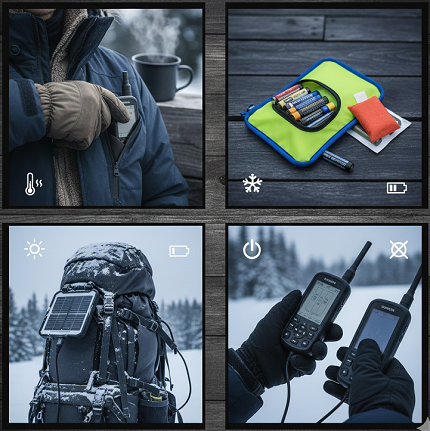
This is the golden rule. Your body is an excellent heat source, maintaining a core temperature around 98.6°F (37°C) that can keep your devices within optimal operating ranges. When not actively navigating, store your GPS device in an interior pocket of your jacket, close to your body. Professional outdoor guides and polar explorers consistently emphasize this technique as the single most effective strategy for maintaining electronics in extreme conditions.
Avoid leaving your GPS exposed on a backpack strap or bike mount for extended periods in extreme cold. Field testing by experienced mountaineers and winter backpackers has documented that devices worn exposed to ambient temperatures below -10°C (-4°F) typically experience rapid battery depletion, often shutting down within 30-60 minutes even with fully charged batteries. For longer stops, turn the device off and tuck it inside your layers. Many users report success keeping devices at chest level in specialized pockets, where body heat provides consistent thermal protection without restricting movement during activities.
The effectiveness of body heat for battery preservation has been extensively documented in polar expedition reports. Antarctic and Arctic explorers routinely keep critical navigation devices, satellite phones, and cameras inside sleeping bags overnight and against their bodies during the day to prevent battery failure that could compromise safety in life-threatening situations.
2. Insulate and Protect
Consider a thermal sleeve or insulated case. Simple neoprene cases (like those for phones) provide a valuable buffer against the ambient cold, slowing the rate of heat loss and maintaining higher internal device temperatures. Field tests comparing insulated versus non-insulated GPS units in freezing conditions show that neoprene cases can extend operational time by 30-50% in temperatures around 0°F.
In a pinch, wrapping the device in a glove or wool sock can help. The goal isn’t to make it toasty, but to reduce the thermal shock and slow the rate of temperature decline. Expedition-grade solutions include specialized battery pouches with fleece or down insulation, which provide superior thermal protection for multi-day winter trips where battery performance is critical for navigation and safety.
Some specialized outdoor power banks now incorporate built-in insulation and heating elements specifically designed for cold-weather performance. The Nitecore Summit 10000 and Summit 20000 power banks, for example, feature intelligent heating functions that activate when temperatures drop below freezing, maintaining optimal battery temperature with minimal power consumption. These specialized units can operate effectively at temperatures down to -40°C/-40°F, providing reliable charging capacity even on Mount Everest.

3. Optimize Device Settings Before You Head Out
Reduce Screen Brightness: The display is a major power drain, often consuming 30-40% of total battery capacity in GPS devices. Reducing brightness to the minimum readable level can significantly extend battery life, particularly in winter conditions when battery capacity is already compromised. In bright snow conditions with high reflectivity, you may find that lower brightness settings are still perfectly readable.
Turn Off Unnecessary Features: Disable Bluetooth, Wi-Fi, and background data syncing unless needed. Modern GPS devices often attempt to maintain multiple wireless connections simultaneously, each of which consumes power. Garmin forums document that users frequently report 15-20% improvements in battery life simply by disabling GLONASS or Galileo satellite systems when GPS alone provides adequate accuracy, and turning off smartphone notifications and connectivity features when not needed.
Shorten the Screen Timeout: Set the screen to turn off after 15-30 seconds of inactivity. Many GPS devices ship with default timeout settings of 60 seconds or longer, which unnecessarily drains batteries when the screen remains illuminated during brief pauses in navigation. Battery save mode on devices like the Garmin Edge series can turn off the screen unless touched, dramatically extending battery life during long rides or hikes.
Use a Static Map Screen: When on a known trail, switch from active navigation mode to a simple map view. Continuous route calculation and real-time turn-by-turn navigation require significantly more processing power than displaying your position on a static map. Field tests show that switching from active navigation to track-logging mode can improve battery life by 20-30% on multi-hour outings.
4. Manage Battery Care
Start Fully Charged: Always begin your trip with a 100% charge. Cold temperatures immediately begin degrading available capacity, so starting with maximum charge provides the best buffer against premature depletion. Manufacturers emphasize that cold-weather operation requires this baseline preparation, as devices may lose 10-15% of displayed capacity within the first 30 minutes of exposure to sub-freezing temperatures.
Keep Spares Warm: Carry extra batteries (if your device uses disposables like AA lithiums) or a power bank in an inner pocket. Testing by outdoor gear reviewers consistently demonstrates that power banks stored in warm environments maintain 70-90% charging efficiency, while those left cold in backpack outer pockets may deliver only 30-50% of their rated capacity when attempting to charge cold devices.
Lithium primary batteries (non-rechargeable) outperform alkaline batteries dramatically in the cold. Energizer Ultimate Lithium AA batteries, rated for operation from -40°F to 140°F, are specifically engineered for extreme temperature performance and can last up to seven times longer than alkaline batteries in cold conditions. These batteries work at temperature extremes where other types fail completely, making them the gold standard for GPS devices, trail cameras, and emergency equipment used in winter environments.
Independent cold-weather testing of AA batteries shows that at -20°C, alkaline batteries like Duracell experience catastrophic performance degradation, dropping to 1.0V after just 40 minutes under modest loads. In contrast, both Energizer and GP lithium AA batteries maintain 1.35V or higher under identical conditions, demonstrating the significant advantage of lithium chemistry in cold weather. Field testers emphasize that for serious low-temperature use, lithium batteries are not optional—they’re essential.
For rechargeables, keep the power bank warm to ensure it can deliver its charge. Testing by outdoor gear laboratories shows that some power banks like the Goal Zero Venture 35 and certain UGREEN and Miady models actually perform better in cold weather than at room temperature, with increased efficiency when temperatures drop. However, most standard lithium-ion power banks experience 20-40% capacity loss in cold conditions. The key is maintaining core temperature through insulation and body heat.
Specialized cold-weather power banks incorporate technologies specifically designed for winter performance. Models like the Nitecore Summit series and Xtorm Rugged Power Banks feature insulated construction, heating elements, and cell chemistry optimized for low-temperature operation. These specialized units maintain reliable charging capacity down to -40°C, making them essential equipment for serious winter expeditions where standard power banks would fail.
Avoid Recharging a Frozen Battery: If your device or spare batteries become ice-cold, allow them to warm up gradually (e.g., in a pocket close to your body) before attempting to recharge, which can damage the cells. This critical precaution protects against lithium plating, a damaging phenomenon that occurs when lithium-ion batteries are charged below freezing.
Below 32°F (0°C), lithium ions aren’t efficiently captured by the anode during charging. Instead, many ions coat the surface of the anode in a process called lithium plating, which permanently reduces battery capacity and increases internal resistance. If sufficient plating builds up, it can puncture the separator membrane inside the cell and create dangerous internal short circuits. Battery manufacturers specify that charging lithium-ion batteries below freezing requires reduced charge rates: at temperatures between 0°C and -10°C, charging current should not exceed 1C; between -10°C and -20°C, rates must be limited to 0.05C to prevent permanent damage.
The specialized RELiON LT Series lithium batteries represent an exception to these limitations, featuring integrated heating elements that warm the battery before commencing charge at temperatures down to -4°F, allowing continuous charging without the need for reduced current that would extend charging times impractically.
5. The “Pre-Warm” Technique
If storing your GPS in a cold car or tent overnight, place it (and its batteries) inside your sleeping bag. Starting the day with a warm device extends its initial operational window significantly. Experienced winter campers and mountaineers report that this simple technique can provide 1-2 hours of additional operating time before the device cools to ambient temperature and battery performance begins degrading.
Polar expedition protocols developed by professional explorers include placing all critical electronics, power banks, and spare batteries inside the sleeping bag at night, often positioned near a hot water bottle for additional warmth. This practice ensures that devices begin each day at optimal operating temperature, maximizing available battery capacity during the critical morning hours when temperatures are typically coldest.
Some adventurers go further, keeping power banks and GPS devices against their bodies 24/7 during multi-day cold-weather expeditions. While this adds minor discomfort and bulk, the trade-off for reliable navigation and communication in life-threatening environments makes the strategy worthwhile. The general principle remains consistent: warm batteries perform better, and pre-warming before use provides measurable benefits.
6. Know Your Tech: Alt. Power Options
For multi-day winter expeditions, consider:
Solar Chargers: Effective if you get sufficient winter sunlight, but pair with a battery bank to store the charge. Winter solar charging faces challenges from shorter daylight hours, lower sun angles, and frequently overcast conditions, but Goal Zero and similar manufacturers offer robust systems designed for expedition use. However, solar panels alone cannot maintain power in high-latitude winter conditions—they must be paired with insulated battery banks that can store collected energy without losing it overnight to cold temperatures.
Hand-Crank Chargers: A reliable, muscle-powered emergency backup that functions independently of battery chemistry and temperature limitations. While tedious for regular use, hand-crank chargers provide critical redundancy when all other power sources fail in extreme conditions.
Device-Specific External Batteries: Some GPS models offer external battery packs that can be kept warm more easily than the entire device. Garmin’s external battery solutions for devices like the Montana series allow users to keep the supplementary power source in an insulated pocket while the GPS itself remains mounted and exposed, significantly extending operational time in cold conditions.
Expedition-Grade Power Systems: Professional mountaineers and polar explorers increasingly use integrated power management systems combining solar panels, high-capacity lithium batteries with heating elements, and voltage regulators designed for extreme conditions. These systems, while expensive and heavy, provide the reliability necessary for extended expeditions where electronic failure could compromise safety.
What NOT to Do
Don’t expose a cold device to sudden, intense heat (like a campfire, heater vent, or heaven forbid, a microwave). This can cause damaging condensation inside the unit and is a fire hazard. Rapid temperature changes from extreme cold to high heat cause moisture in the air to condense on and inside electronic components, potentially creating short circuits and corrosion that permanently damage sensitive circuitry.
Don’t store devices in unheated vehicles for long periods. Prolonged exposure to deep cold can cause long-term battery damage, including permanent capacity loss and increased internal resistance that persists even after the battery is warmed. Modern lithium-ion batteries suffer from mechanical degradation when repeatedly subjected to extreme temperature cycling, shortening their overall lifespan beyond the immediate cold-weather performance issues.
Don’t ignore the manufacturer’s stated operating temperature ranges. Most consumer electronics are rated for operation down to 32°F (0°C); specialized outdoor gear may be rated much lower. Garmin’s outdoor GPS units typically specify operating ranges from -20°C to 60°C (-4°F to 140°F), but real-world user experiences documented in forums show that many devices struggle to maintain reliable operation below -15°C without careful thermal management.
Don’t assume all batteries are created equal. Standard alkaline batteries experience catastrophic performance degradation in cold weather, losing 50% or more of their capacity at 0°F. Testing shows that at -20°C, alkaline batteries become essentially unusable under moderate loads, while lithium batteries maintain 85-90% of their room-temperature capacity under identical conditions.
Don’t neglect power bank care. Standard power banks stored in cold environments lose significant capacity and charging efficiency. Field tests show that power banks left in backpack outer pockets or attached to pack exteriors in sub-freezing temperatures may deliver as little as 30-40% of their rated capacity, while those kept warm in interior pockets maintain 80-90% efficiency.
The Ultimate Safety Net: Analog Backup
No battery strategy is 100% foolproof in extreme conditions. Your most critical piece of “cold-weather maintenance” is a hardcopy map and a compass—and the knowledge to use them. Inform someone of your route and expected return time.
Professional mountaineering organizations and search-and-rescue authorities emphasize that electronic navigation devices, regardless of battery management strategies, should never be the sole means of navigation in wilderness environments. Paper maps in waterproof cases, magnetic compasses (which function independently of temperature and batteries), and the skill to use them remain essential equipment for any serious outdoor pursuit in winter conditions.
GPS satellites may fail to acquire signal in deep canyons, dense forest, or severe weather conditions. Devices may suffer catastrophic failure from impacts, water ingress, or extreme cold beyond your ability to manage. Having alternative navigation capabilities ensures you can continue safely even when electronics fail completely.
By treating your GPS battery as a cold-sensitive component and adopting these strategies, you can ensure your digital guide remains functional, keeping you on track and safe while you enjoy the stark beauty of the winter world. However, always remember that technology serves as an aid to, not a replacement for, fundamental wilderness navigation skills and proper expedition planning.
*) If you enjoyed this article, here are some related posts you might find interesting.
Year-End Review: GPS Technology Leaps Forward in 2025
Navigate the Wild: The Best GPS Units for Off-Road Vehicles
Garmin vs. Apple Watch: The Ultimate Outdoor Adventure Guide